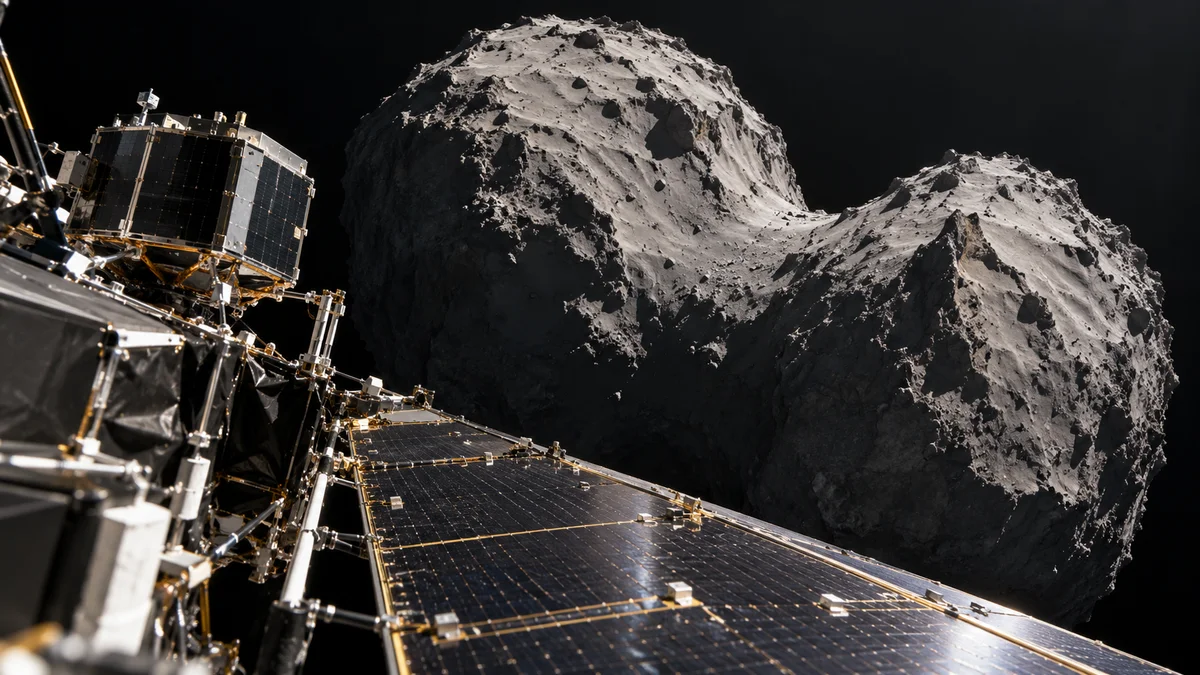
Rosetta’s selfie was taken by a camera on Philae, the lander still attached to the spacecraft. Comet 67P appears behind them. The photograph dates from 7 October 2014; its appearance as NASA’s Astronomy Picture of the Day on 24 October 2026 is a new presentation of an earlier image, not a new visit to the comet. NASA’s image description identifies both the camera and the dates.
The useful way to read this picture is to change viewpoints. It shows what a camera travelling with the spacecraft could see nearby. Solar System Live shows the Sun and planets on a much broader scale. Our earlier article about a stereo image of comet 67P starts with the comet’s shape; here, the foreground spacecraft gives us a reference for who was looking.
Where was the camera?
It was in Philae’s CIVA imaging system. Philae had not yet separated from Rosetta, so the camera could look back at part of its carrier while keeping the comet in the background. The European Space Agency’s account of the image identifies the visible spacecraft structure and one of Rosetta’s solar arrays.
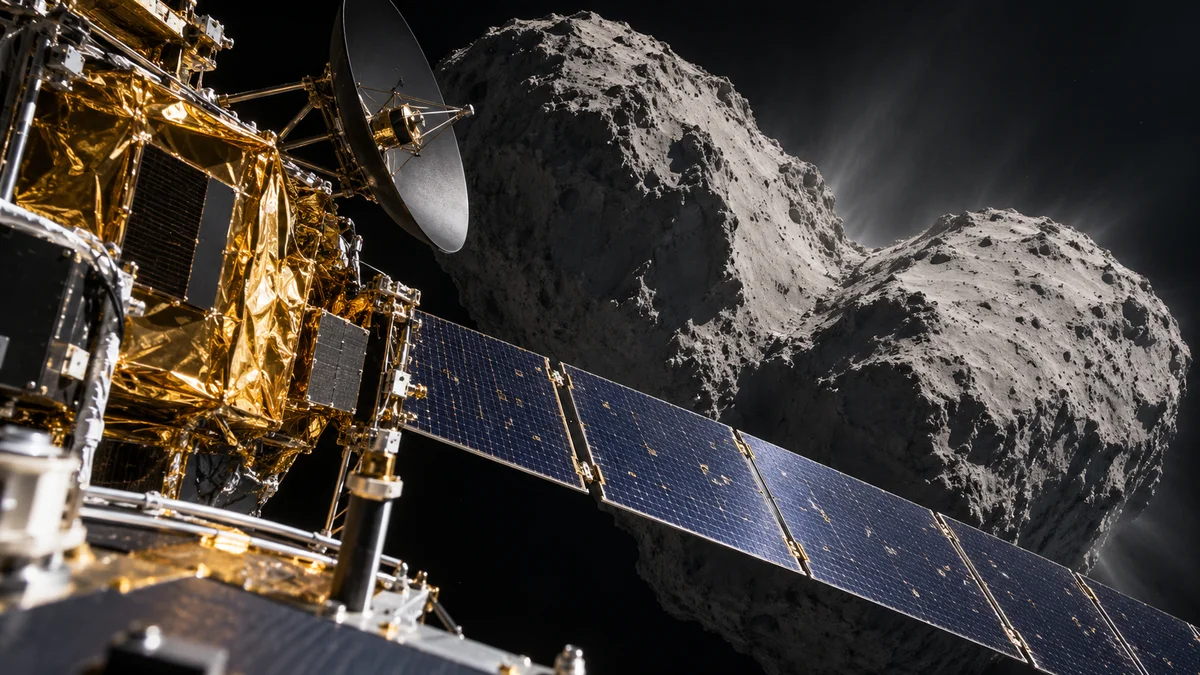
That arrangement explains the word selfie, but it can also mislead. The image was not taken by a camera floating independently between Rosetta and 67P. Nor was it taken from the comet’s surface. Philae was still aboard the spacecraft when it made these exposures.
NASA says the spacecraft was about 16 kilometres from the comet’s surface and 472 million kilometres from Earth. Those distances refer to different pairs of objects. One describes the camera’s immediate setting beside 67P; the other tells us how far this scene lay from observers at home. Neither distance can be measured by placing a ruler across the picture.
What can we identify in the frame?
Start in the foreground, then look past it. A bright solar array belongs to Rosetta. Beyond the spacecraft is 67P’s two-lobed nucleus. Near the region joining its lobes, streams of dust and gas extend away from the comet. ESA identifies that active region in its original mission report.
| Part of the view | What it establishes | What it cannot establish alone | |---|---|---| | Rosetta and its solar array | The camera was close enough to include its carrier in the frame | The spacecraft’s whole route through the Solar System | | Comet 67P behind it | The camera and comet were together in the scene | The comet’s present position | | Dust and gas near the nucleus | Activity was visible when the image was made | The composition and source of every visible stream | | Bright and dark details together | Both spacecraft and comet can be inspected | That a single exposure captured them equally clearly |
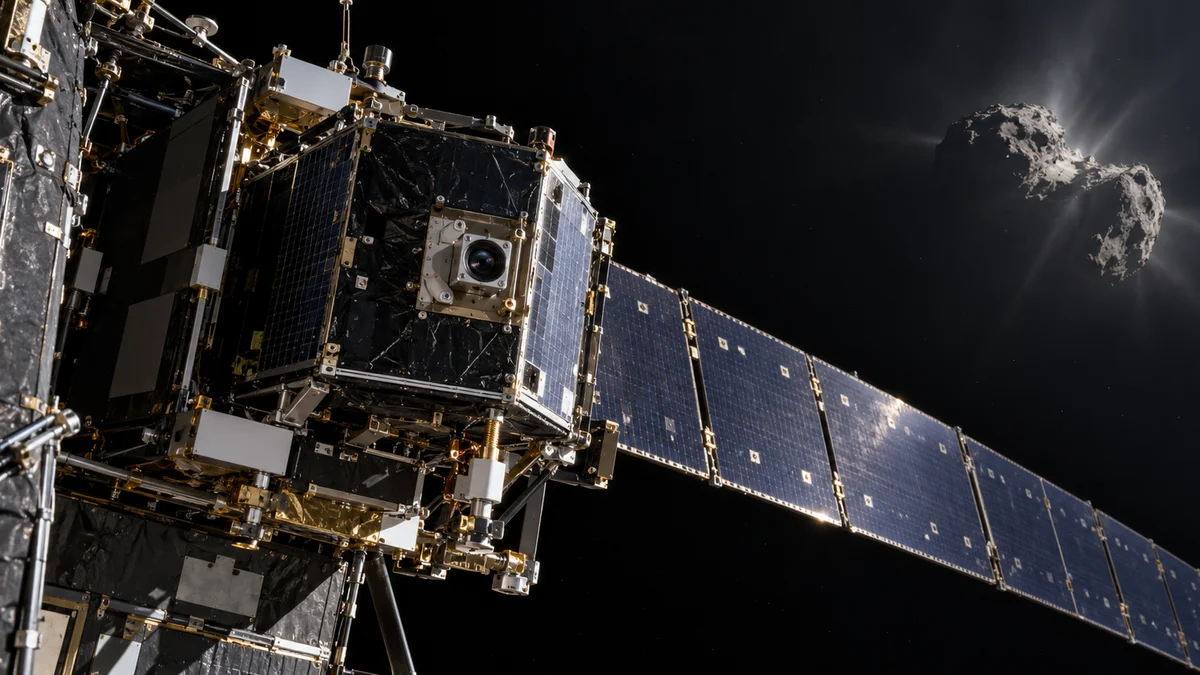
The last row matters. ESA says the published scene combines two exposures, one short and one long, to retain detail in the bright array and the dark comet. It is a photograph assembled from camera exposures, not an artist’s reconstruction. It should still be read with its imaging method in mind: the apparent brightness of one feature relative to another is not a simple measurement from a single exposure.
How does this close-up fit into a Solar System view?
A close-up can make Rosetta and 67P seem like the whole story. The NASA guide to 67P supplies the wider setting: the comet follows a path that crosses the orbits of Mars and Jupiter and approaches, without reaching, Earth’s orbit. That describes its path around the Sun, not where it is today.
Use Solar System Live to locate the Sun, Earth, Mars and Jupiter. Then return to the selfie and ask a more precise question: which distance am I trying to understand? The simulator provides planetary reference points; it does not show this historical camera view or track the comet’s current position. For another look at the difficulty of meeting a moving comet, read our article on a proposed mission to Halley’s Comet.
Finally, compare Rosetta’s selfie with our 67P stereo-image guide. In the selfie, find the camera’s carrier first; in the stereo view, study the nucleus. The two pictures answer different questions about the same comet.