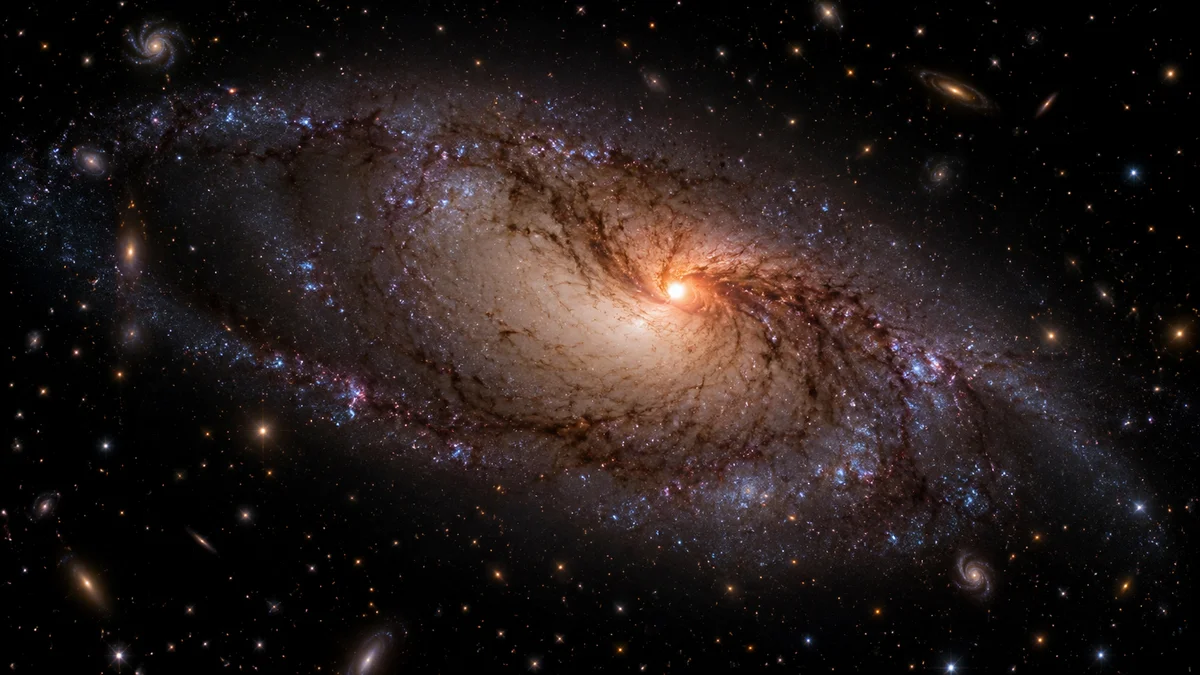
The new quasar survey found a statistical pattern consistent with supermassive black holes recoiling after mergers. It did not prove that any particular black hole was expelled. “Ejected” also needs a boundary: a black hole can move away from its galaxy’s centre without escaping the galaxy.
That distinction matters on a site devoted to the Solar System. The research paper concerns the centres of other galaxies, while Solar System Live represents our planetary neighbourhood. Putting those views beside our existing black hole guides helps answer the reader’s practical question: what has moved, relative to what?
What could give a black hole a kick?
When two supermassive black holes merge, the resulting gravitational waves need not carry energy equally in every direction. The remnant can recoil. Depending on its motion and its host galaxy, it might travel away entirely or move back and forth around the galactic centre. The study’s introduction describes that proposed motion and the observational difficulty it creates: an unusual-looking quasar alone can have more than one explanation.
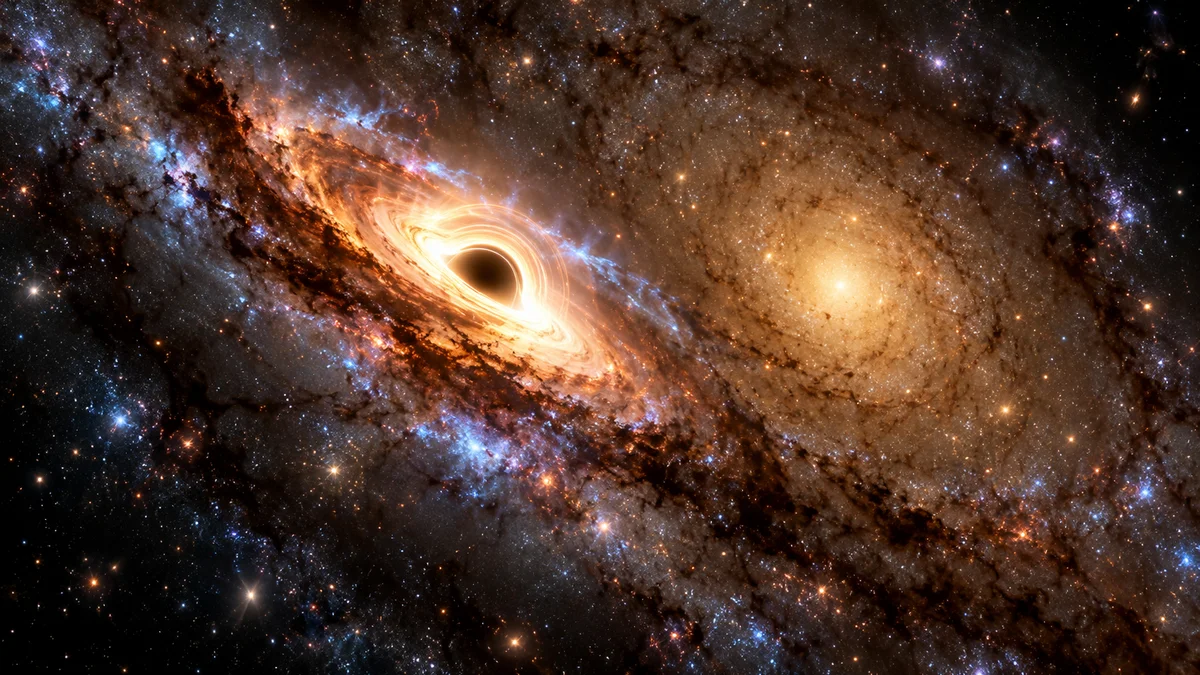
A quasar is useful here because gas near an active black hole emits light that astronomers can study. The team did not film a black hole crossing a galaxy. It tested whether a predicted relationship appears across a large collection of quasar observations.
What did the researchers actually measure?
Using the Sloan Digital Sky Survey’s DR16 quasar catalogue, the authors analysed about 100,000 quasars that met their spectral requirements. They compared two proxies: the velocity difference between broad and narrow spectral lines, used to estimate motion relative to the host’s central region; and a quasar’s colour relative to comparable quasars, used to estimate how much dust reddens its light. The methods and results report that larger velocity offsets tend to occur with greater reddening.
| Question | What the survey supplies | What it does not supply | |---|---|---| | Is there a signal across the sample? | A modest but statistically strong association between the two proxies | A direct view of each black hole’s path | | Does the signal fit recoil? | A pattern predicted for a population of recoiling black holes | Proof that recoil is its only cause | | Has one object been confirmed as expelled? | Evidence about a population | An unambiguous identification of an individual |
This is why sample size and certainty must be read separately. The paper reports a correlation of about 0.12 by one statistical measure: detectable across the sample, yet weak as a way to classify a single quasar. The authors also find differences that could reflect other effects, including gas flows or viewing angle. Their conclusion calls for further tests.
Is this about a black hole near the Sun?
No. Our guide to black holes near the Solar System asks whether a nearby object has been identified. Our article about stars close to Sagittarius A concerns the centre of our* galaxy. The new survey asks a third question: whether light from many active galactic centres contains a population-wide trace of earlier mergers.
These are different searches, not successive sightings of one travelling black hole. NASA identifies Sagittarius A* as the Milky Way’s central supermassive black hole; the quasar survey does not say that it recoiled. Nor does a proposed recoil in another galaxy imply a change to the planets shown in Solar System Live.
Open Solar System Live and locate the Sun to set the scale of the planetary view. Then read the paper’s abstract again, paying attention to the words proxy, correlation and if confirmed. They mark the distance between a promising population signal and a confirmed ejected black hole.