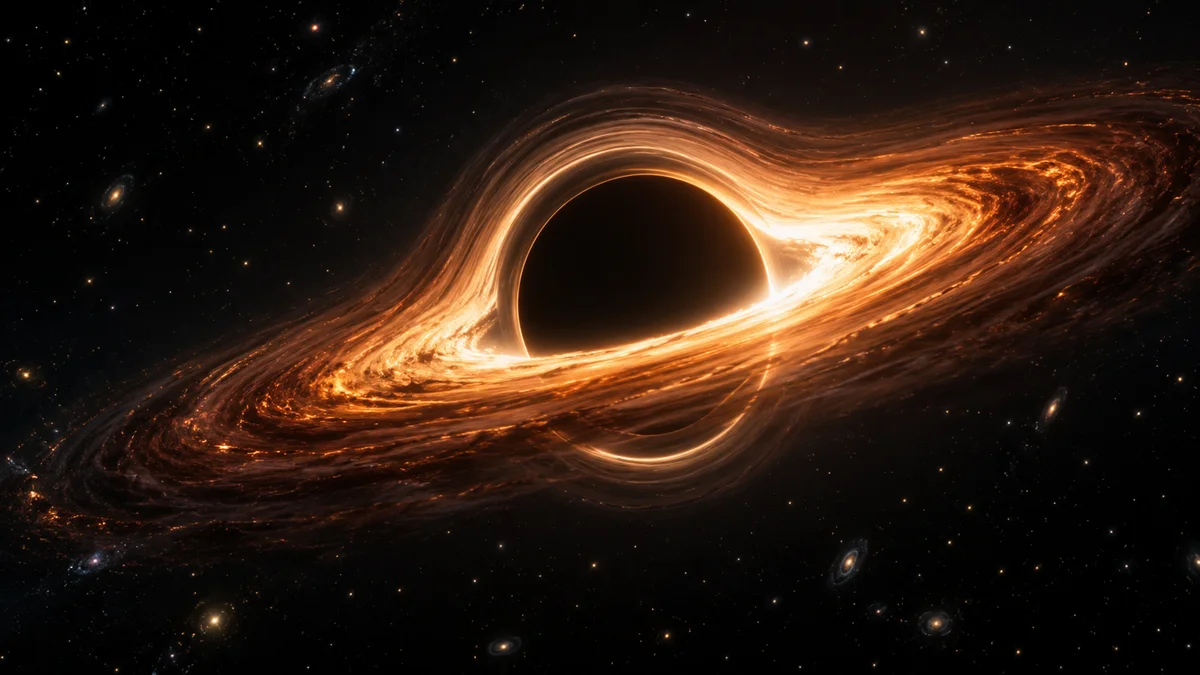
The new study does not demonstrate a black hole breaking apart. It investigates conditions that might permit fragmentation, leaving the process that would cause it unspecified. That distinction appears in the research published on 22 October 2026 in Physical Review D.
For readers of Solar System Live, the useful question is how to read the striking branching diagram. Our archive already separates astronomical pictures from simulations. Here we add another category: a drawing of a hypothetical transition. By the end, you should be able to explain what that drawing establishes—and what evidence you would still need.
Does rapid rotation make a black hole split?
Not automatically. The authors find that motion and conservation constraints obstruct fragmentation even where the entropy comparison might permit it, with a possible opening near the maximum spin. Their calculation is conditional, rather than a prediction that every sufficiently fast spinner must break apart. See the published abstract.
The University of Southern Denmark’s explanation adds the practical obstacle: the resulting objects must separate instead of falling back together. The researchers cannot yet assign a single probability to splitting.
When retelling the result, keep “might permit” attached to the conditions. Replacing it with “will cause” changes the claim.
Why is the ordinary case blocked?
For a nonrotating black hole in ordinary general relativity, splitting would lower the total entropy, conflicting with thermodynamics. The researchers also consider other settings, including additional spatial dimensions and modified gravity. The participating University of Naples explains these alternatives.
That gives you a useful question for any proposed exception: which assumptions have changed? Put the answer beside the conclusion. Otherwise, a result obtained in a particular theoretical setting can sound like a general rule about every black hole.
What does the trouser-shaped diagram represent?
The waist represents one black hole; the legs represent two at a later time. The shape describes a possible evolution through time, as Naples explains.
Read it as a sequence. First identify the proposed starting state, then the proposed ending state. Finally ask what connects them. A helpful exercise is to cover the connecting section: what information would you need before drawing it back in?
The distinction is especially useful on a site built around visual exploration. Before interpreting a convincing shape, establish the job that its creator intended it to do.
Which Solar System Live guide helps with each doubt?
This comparison is our reading route through the archive, not a set of new astronomical measurements.
| Your question | Where to look | What to record | |---|---|---| | Does computer processing make a picture fictional? | [Our black-hole picture guide](/articulos/foto-agujero-negro-real-o-simulacion/) | Where the input information came from | | What can a modeled image establish? | [Our dark matter simulation guide](/articulos/simulacion-materia-oscura-que-muestra-la-imagen/) | The question the model addresses | | Does a branching sketch demonstrate a breakup? | The fragmentation paper linked above | Which conditions were tested and which process remains unspecified |
Choose the row that matches your confusion. You do not need to settle every question about black holes before learning to read this particular result accurately.
What should you check next?
Open the university’s illustrated explanation. It explicitly distinguishes a thermodynamically favourable possibility from proof that fragmentation occurs.
Write a caption beginning “This diagram represents a hypothetical…”. Then add one sentence naming the unresolved step. You will have a more useful account than a dramatic picture alone: a proposed transition, its constraints and the evidence still needed.