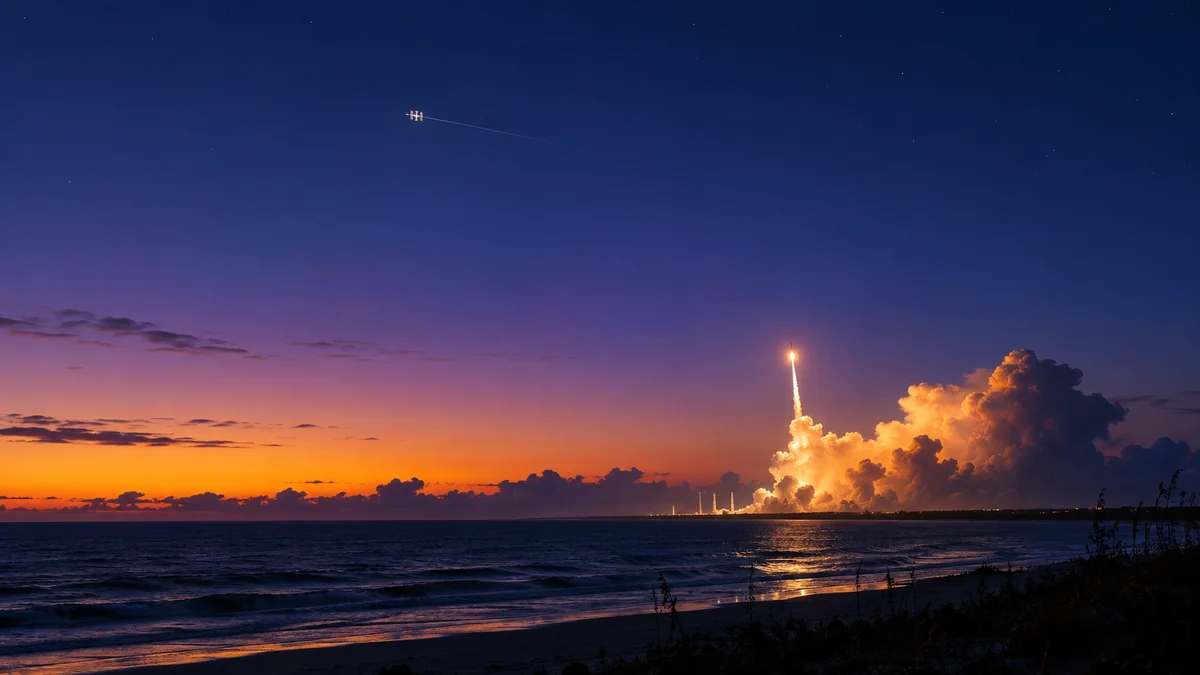
The bright streak crossing the sky is the International Space Station; the growing luminous cloud belongs to the Falcon 9 launch. Both appear in the same predawn timelapse, but the image does not show Dragon reaching the station. NASA’s October 16 Astronomy Picture of the Day records the beginning of a cargo mission from a camera on the Florida coast. NASA’s station report documents the docking separately.
That distinction is the key to reading the video. A camera turns movement through space into movement across one person’s sky. Solar System Live supplies the wider Earth-and-Sun setting; our existing guides cover the station’s speed and orbital rendezvous. Here, we can put those views together to answer a different question: what does this particular recording let us see?
Which light belongs to which object?
The APOD description identifies three parts of the scene. Falcon 9 lifts off carrying an uncrewed Dragon spacecraft. The ISS enters from the top of the frame about eight seconds into the 30-second timelapse and appears to move downward toward the horizon. Later, the video shows burns associated with the rocket’s returning first stage. The illuminated exhaust cloud continues to drift in the sky.
| What you notice | What NASA identifies | What the image alone cannot tell you | |---|---|---| | A bright mark crossing from high in the frame toward the horizon | The ISS, seen from the camera’s location | Dragon’s distance from the station | | A spreading, glowing cloud | Sunlit rocket exhaust | The spacecraft’s exact position within that cloud | | Later, separate bright burns | The Falcon 9 first stage returning | Whether Dragon has docked |
The table matters because the most conspicuous feature is not necessarily the spacecraft carrying the cargo. Nor does “down” on the screen mean that the station is falling toward Earth. It describes the station’s apparent direction in this camera’s view.
Why does the plume shine before sunrise?
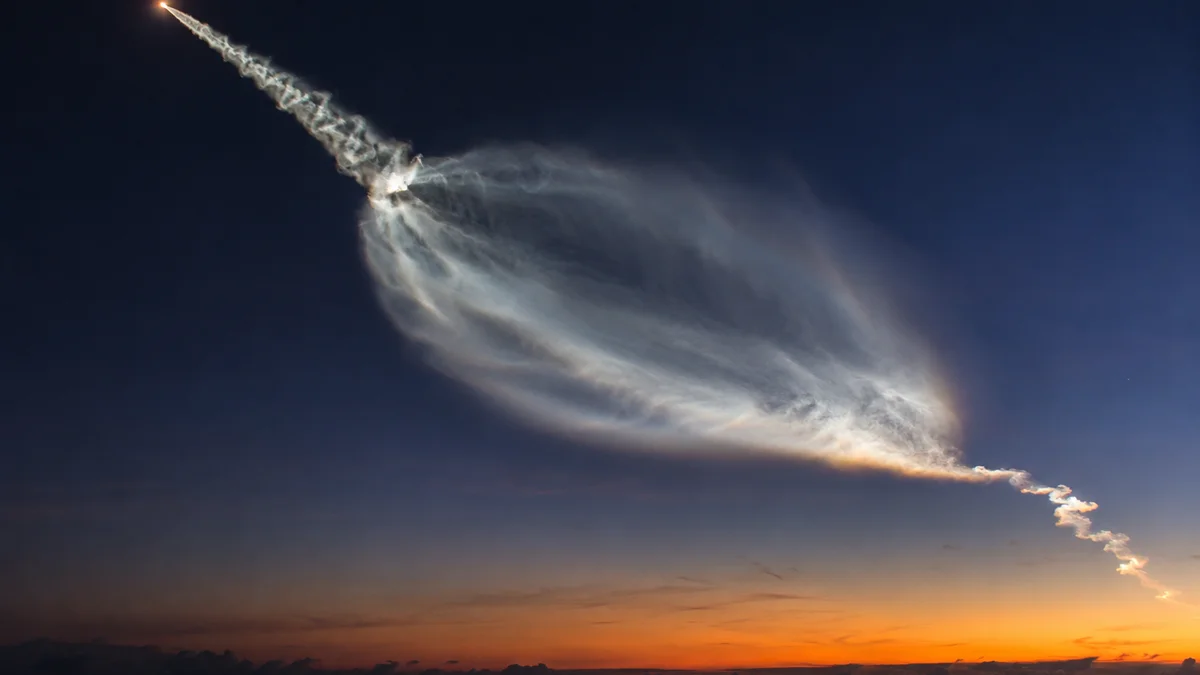
NASA’s photograph of the same launch explains the broad glow: sunlight illuminates the exhaust while the launch is viewed near sunrise. From the ground, the sky can still look dark even when material higher up catches the Sun. The resulting bright shape is often called a jellyfish plume.
The ISS is visible for a different reason. It reflects sunlight; NASA’s Spot the Station guidance explains why a station pass can be visible against a darker sky around twilight. In this scene, sunlight helps reveal two different things: a solid station moving across the camera’s field of view and an expanding cloud left by a rocket. Their appearance in one frame does not place them side by side in space.
Did the Dragon catch the ISS in the video?
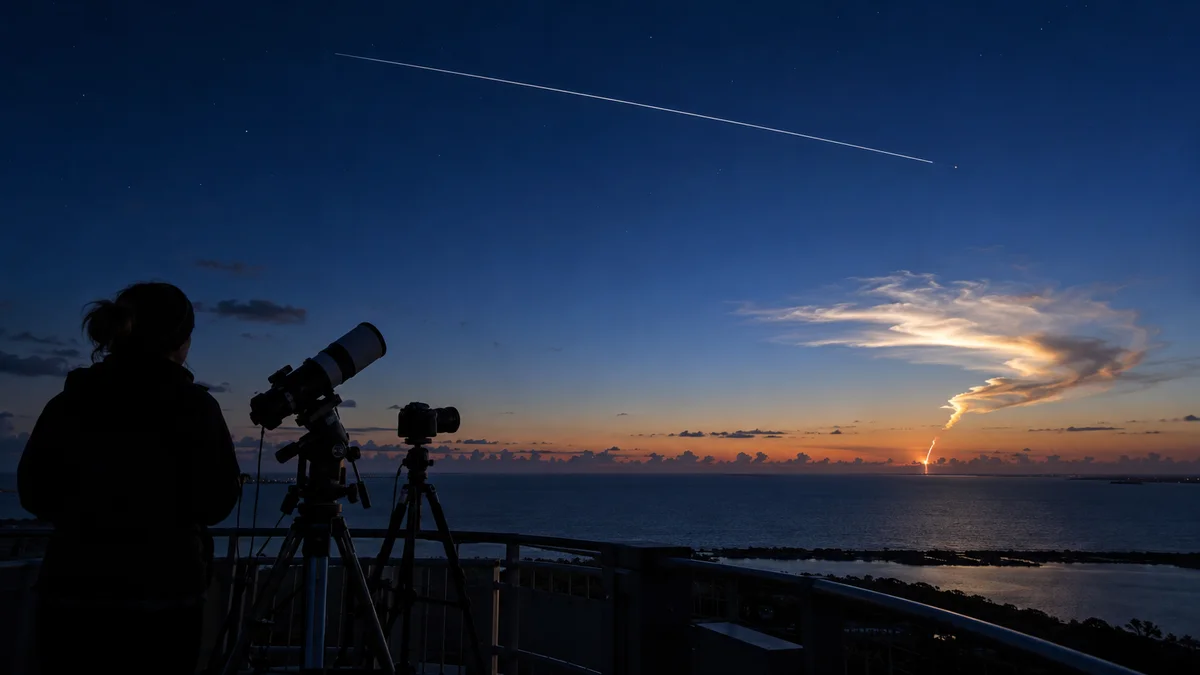
No docking is shown in the APOD timelapse. NASA reports that the cargo Dragon launched on October 13 and docked with the ISS on October 15. The video and the docking report answer different questions: one records what an observer saw from Earth at launch; the other confirms the later arrival.
For the orbital part of that journey, read our guide to Progress 96 and ISS rendezvous. It explains why reaching the station requires matching orbital motion, rather than following the line a streak draws across a camera frame. Our article on how fast the ISS orbits Earth adds context for the station’s movement. Neither a speed figure nor a launch timelapse gives the distance between these two spacecraft at a particular instant.
What does the simulator add?
Open Earth and the Sun in Solar System Live before replaying the NASA video. Use the planetary view to think about illumination, then return to the ground-level view and identify the station, the plume and the later first-stage burns in turn. The simulator provides the larger setting; it does not track the ISS or Dragon in this clip.
The practical next step is to watch the timelapse once for the ISS and once for the rocket. Then consult NASA’s docking report for the event the camera could not show.