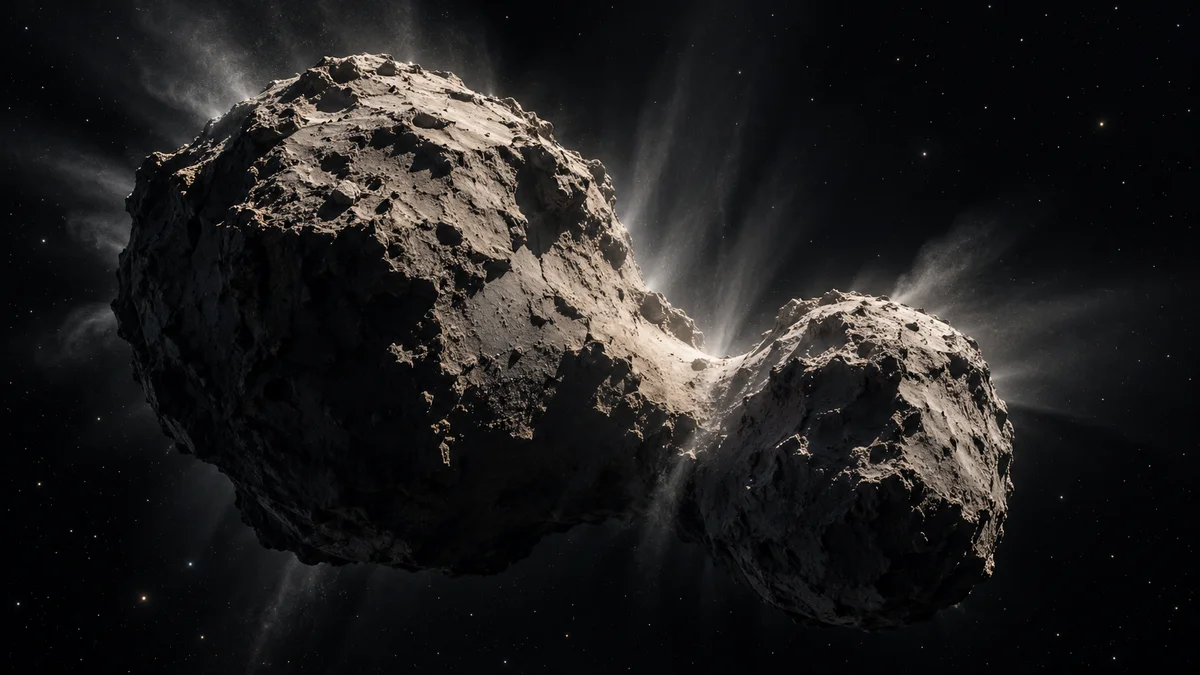
The comet 67P 3D image is a stereo view of its two-lobed nucleus and the jets leaving it. It combines two pictures taken by the Rosetta spacecraft; it is neither a live view nor a picture taken in 2026. NASA’s October 17 Astronomy Picture of the Day dates the source images to July 25, 2015, when Rosetta was 184 kilometres from the comet.
That close-up answers a question our planetary view cannot: what did the comet look like from nearby? Solar System Live offers a different scale: the Sun and planets that help place the comet’s journey. Read the image first, then step back to the Solar System.
Why does 67P look like two joined objects?
The dark central shape is the nucleus, with a larger lobe, a smaller lobe and a narrow connection between them. NASA describes the larger lobe as roughly 4 kilometres across and the smaller as roughly 2.5 kilometres across in its explanation of the image. The stereo effect helps your eyes separate the lobes and the irregular edges.
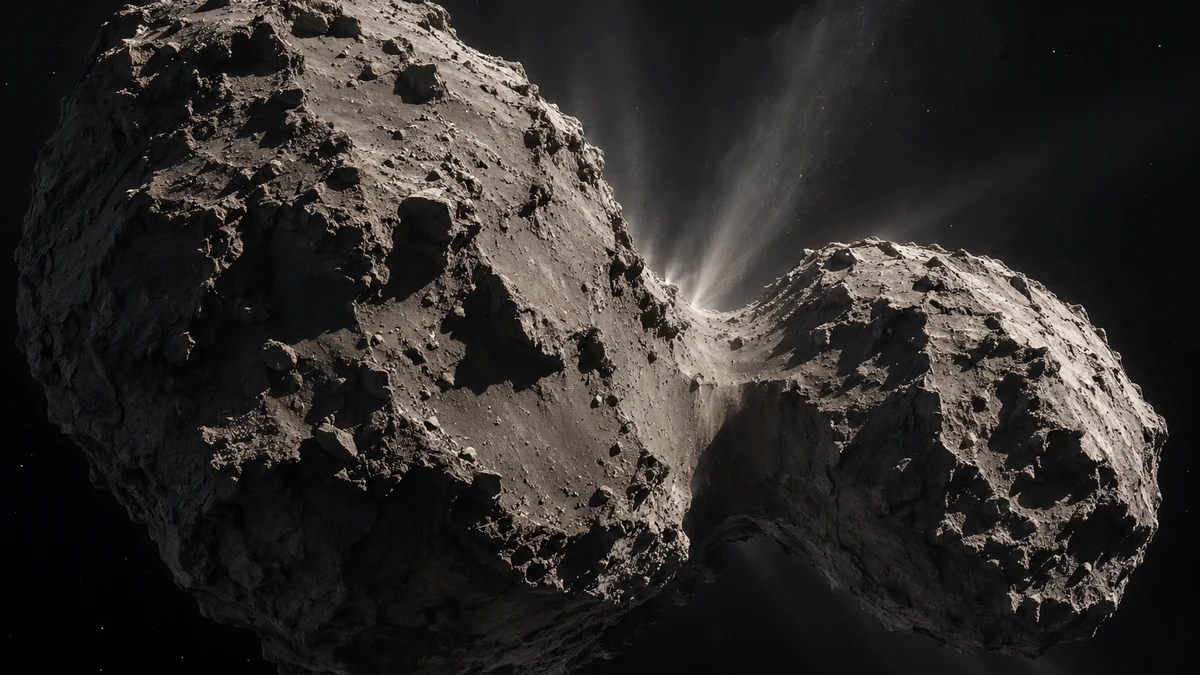
Shape alone does not explain how the comet formed. ESA’s account of Rosetta’s measurements describes varied terrain across the nucleus, including dusty areas, pits, depressions and more consolidated surfaces. It also distinguishes what images reveal from questions that require further analysis. A three-dimensional impression is valuable for reading the landscape; it is not a recording of the events that made it.
What are the bright streaks around the nucleus?
They are jets associated with the comet’s activity, identified in the APOD description. ESA explains that heating can turn ice directly into gas and carry dust away from the surface. Its Rosetta report notes activity in the neck region and jets rising from pits elsewhere.
Look at the streaks separately from the solid outline. The image shows material leaving the neighbourhood of the nucleus; it does not, by itself, identify the composition or exact source of every streak. Nor should the red and blue used to make the stereo view be read as a map of the comet’s natural colours. For another example of the technique, ESA has published a different Rosetta jet anaglyph.
| View | What it helps you answer | What it does not establish | |---|---|---| | Rosetta’s stereo image | What the nucleus and nearby jets looked like from the spacecraft | Where 67P is today | | NASA’s 67P orbit guide | How its path relates to planetary orbits | The detail of a jet in the APOD image | | Solar System Live | Where the Sun and planets sit in a planetary view | A live view or tracked orbit of 67P |

Where does this small nucleus travel?
NASA’s comet guide says 67P follows an orbit crossing those of Mars and Jupiter. At its closest point to the Sun, it approaches Earth’s orbit but does not reach it. Those statements describe an orbital path, not the comet’s position on the day you read this article.
In Solar System Live, use the Sun, Earth, Mars and Jupiter as reference points while reading that description. Then return to Rosetta’s photograph. The comparison connects an object only a few kilometres across with the much larger route it follows around the Sun. The simulator does not display 67P’s nucleus, jets or current trajectory, so the photograph and NASA’s orbit guide remain the sources for those details.
Our article on the proposed Halley’s Comet mission explores a different problem: reaching a comet along its orbit. Our guide to zodiacal light and interplanetary dust follows dust on a far broader scale than the jets beside 67P. Together, they help keep a close-up surface view, an orbital journey and a wider dusty sky distinct.
Open the NASA anaglyph again. Find the two lobes, trace their narrow connection and then look for the jets. Afterward, use the Sun and planets in the simulator to put that close-up back into its Solar System setting.