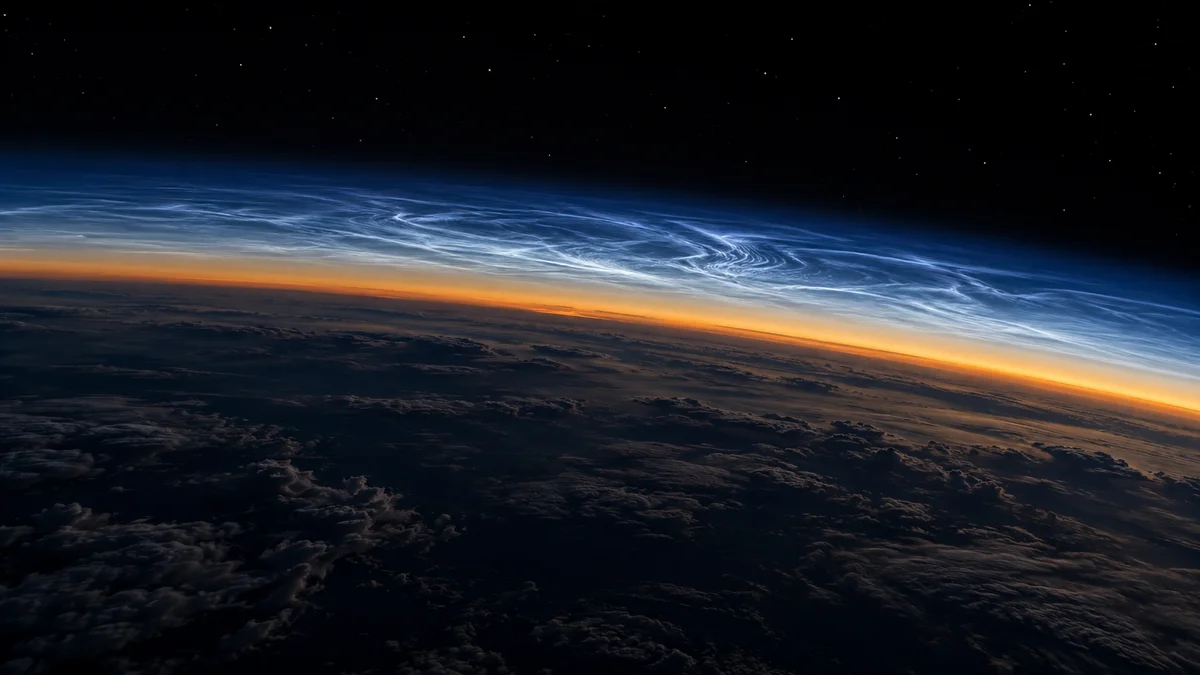
Noctilucent clouds are high atmospheric ice clouds that can remain sunlit after the ground below has entered darkness. Their light comes from the Sun. NASA’s view from the International Space Station explains this apparently contradictory scene.
For Solar System Live readers, they offer a useful change of perspective: start with Earth and the Sun, then put yourself back beneath the atmosphere. The question becomes more precise than “why is that cloud glowing?” It is: where is the observer, and can sunlight still reach the cloud?
Does the Swedish photograph show last night’s sky?
No. The APOD published on 27 October 2026 shows clouds photographed near Linköping, Sweden, in early August 2026, according to NASA’s original description.
That distinction matters when you arrive from a real-time simulator. A current planetary scene and a newly published photograph do not necessarily describe the same moment. Before using any astronomy image to plan an outing, separate its publication date from its observation date.
Here, the caption supplies a summer setting. It does not announce a display happening over Sweden tonight.
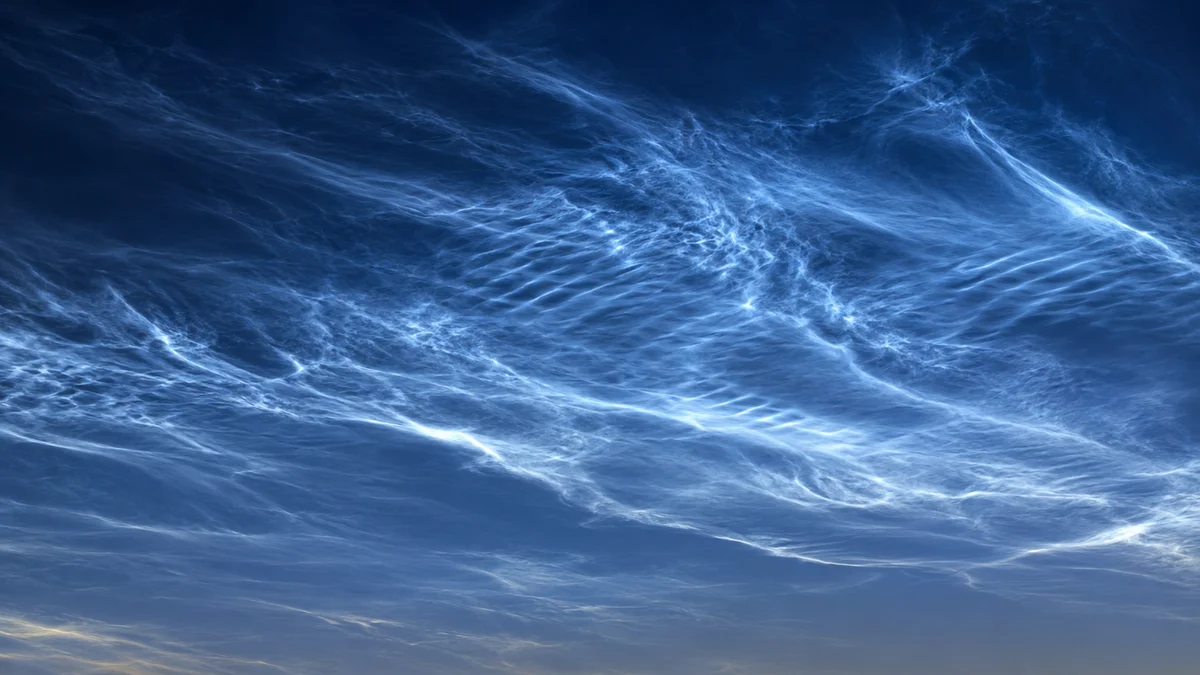
How can sunlight reach a cloud after sunset?
Height changes the geometry. NASA places these clouds roughly 76–85 kilometres above Earth’s surface, near the boundary between the mesosphere and thermosphere. Water vapour can freeze into ice crystals there, and sunlight can reach the clouds while the observer below is in darkness. See NASA’s explanation accompanying the orbital photograph.
Try a simple reading exercise with Solar System Live: locate Earth and the Sun, then imagine an observer standing on Earth near sunset. Keep that observer in mind when you return to the cloud photograph. “Below the horizon” describes the observer’s view; it is not a statement that sunlight has disappeared from every height above them.
Use the simulator for that planetary starting point. Use atmospheric observations to investigate the clouds themselves.
Why are they associated with summer?
The relevant temperature is high in the atmosphere, rather than at your feet. NASA’s “Nocturnal wonders” guide explains that these clouds form most often at high latitudes during summer, when the mesosphere is coldest.
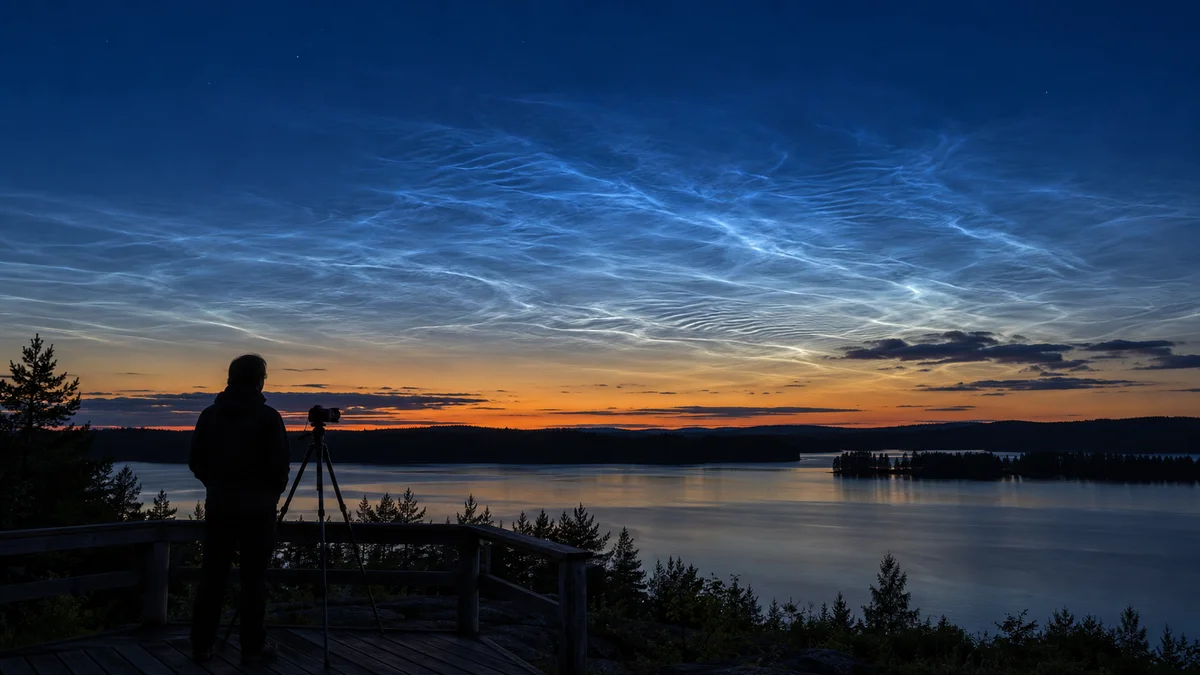
A warm evening on the ground therefore does not tell you whether conditions are suitable where the ice forms. Nor does knowing the season guarantee a sighting at a particular location.
For a first encounter with this subject, keep formation and visibility as separate questions: can ice clouds form up there, and can an observer see them illuminated against the sky?
Which view should I use to understand them?
Our route through the resources follows the observer from a planetary view to the ground and then into orbit. This is an editorial comparison, not a set of measurements made by Solar System Live.
| Resource | Your task | What to avoid assuming | |---|---|---| | Solar System Live | Locate Earth and the Sun as your starting references | That a planetary scene establishes local cloud conditions | | Swedish APOD | Read the capture date before interpreting the scene | That publication means the display happened yesterday | | NASA’s station photograph | Compare an orbital viewpoint with the ground photograph | That the two photographs record the same event | | NASA’s atmospheric explanation | Identify the altitude and conditions involved | That surface warmth describes the upper atmosphere |
Our guide to reading a dark matter simulation develops the same habit of checking what a representation actually answers. For another sky-glow topic in our archive, explore zodiacal light.
Your next step is to open NASA’s orbital cloud photograph beside the Swedish APOD. Identify the observer’s viewpoint in each before comparing the clouds. You will be connecting a planetary setting with an atmospheric observation, rather than expecting one image to explain both.